How to Read Literature Like a Professor Sparknotes Chapter 9
one-Sentence-Summary: How To Read Literature Similar A Professor shows you how to get more out of your reading, past educating y'all about the basics of classic literature and how authors use patterns, themes, memory and symbolism in their work to evangelize their message to yous.
Read in: v minutes
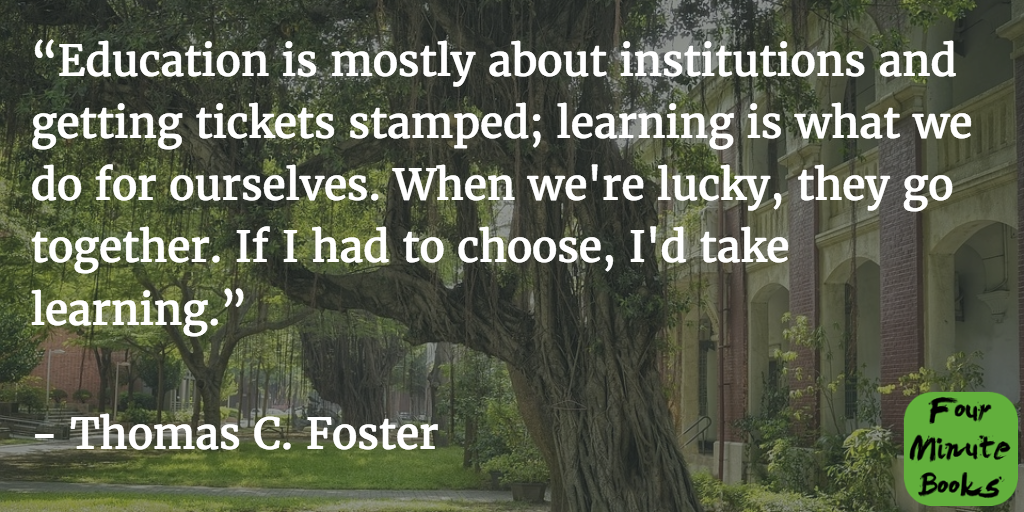
Favorite quote from the writer:
Sound Summary
Listen to the sound of this summary with a free reading.fm account:
I randomly came across How To Read Literature Like A Professor, and found out it was really pop. I'd love to aid you read more and better, and my gears are constantly churning how I can help y'all exercise that (hit me up if you want to hear my product ideas so far). Summarizing this book is surely a skillful beginning.
Thomas C. Foster is an English language professor (surprise), and he uses many examples from archetype books to show you lot how you can unlock what you read and figure out what lies beneath the basic level of the story. This book will non merely brand your reading more fun and more satisfying, you'll also exist able to harness what your learn in a much more than professional way.
Here are three lessons to aid you master the craft of reading:
- Memory, symbols, and patterns are what hide the deeper message in any book.
- One of the most common patterns is the quest structure.
- Wait for universal messages in books to notice which symbols authors use.
Want to read literature like a professor? Allow's accept a literature trip!
If you lot want to save this summary for later, download the complimentary PDF and read it whenever you want.
Download PDF
Lesson one: Well-nigh books hide their message using memory, symbols and patterns.
The majority of people falls into the category of shallow readers. When they read books, they merely pay attending to the bones story level, simply non much more. If you want to go beyond that and actuallyinterpret what y'all're reading, Foster says there are 3 things you need to scout out for.
- Retentivity. This has happened to you for sure. You've read a chapter in a book and thought: "Wait, don't I know this scenario? Haven't I read about this earlier?" Clever readers don't brush off that gut reaction. Instead, they dwell on it and draw an bodily comparison between what they just read and how it'southward different from a similar book they've read in the past.
- Symbols. The scar on Harry Potter's brow is much more than just a scar. Its shape, the way it hurts, the visions he has because of it. It stands for much more than an blow, information technology'southward a symbol, and only if you lot can interpret it you'll get the total picture of the story.
- Patterns. Sometimes trivial and seemingly meaningless details popular up again and again. Just like the story itself near often follows a design, so do certain characters, items and even words people apply. Authors often use patterns to communicate subconscious messages.
But spotting these and interpreting them correctly is hard, and so let'south await at two things y'all can do to meliorate.
Lesson two: The quest structure is one of the most common patterns in literature.
1 of the most universally practical structures in novels, which you can find anywhere in life (even in your latest trip to the grocery store), is the quest construction. It'south sometimes also called the hero's journeying and it always contains the v following things:
- A quester
- A destination
- A stated reason to go
- Some challenges forth the mode
- An unexpected revelation
Take The Alchemist by Paulo Coelho, for case. Santiago, a shepherd, is the quester. His destination are the pyramids of Egypt. He says his reason to go is that he must detect his destiny and explore the vision from his dream (about a treasure in Egypt). Of grade he faces many challenges on his journeying, such equally finding love, only having to get out it backside. At the end, at that place's an unexpected revelation, showing Santiago that the treasure was right in front of him all along.
But if you run out of bread, and it becomes your reason to go to the grocery store, a destination, you become a quester likewise. A challenge might exist to find a parking spot, or arrive at the shop before it closes. Eventually, y'all'll unexpectedly find you lot yet take a loaf at home after you lot come back.
See, it has all the elements of a quest, even though it's a very picayune scenario. At present yous can pay attending and detect the quest structure in other books and events!
Lesson 3: Look for universal letters in books to find which symbols authors employ.
Do you sometimes feel like books are a rip-off? That they're simply blatantly copying from another author? Well, actually it's tough to find a book thatdoesn't copy from a previous one. In truth, no book is 100% original, whether the author knows he or she is copying, or non.
This miracle is called intertextuality – all texts depend on one another – and it'south a proficient thing! When the same ideas announced once again and again information technology turns them into symbols. You tin can so rely on interpreting them correctly, because the aforementioned symbol usually stands for the aforementioned thought.
For instance, whenever a storm is seen on the horizon, this is commonly a symbol for trouble lying ahead, whether in the grade of an bodily storm or a plot twist.
Often, the hero's home is destroyed, and he or she has to first all over. This is usually meant to show that even in destruction, there is a liberating power.
Ask "What's the universal bulletin behind this result?" as you read, and yous'll be able to spot symbols and some of the big ideas, which have been effectually for centuries.
Note: Another thing that helps yous develop this skill is reading a wide diversity of books, especially classics, because these have popularized most of the symbols we apply today.
How To Read Literature Like A Professor Review
I want more of this. More reading most reading. If reading a lot is skilful, and then reading a lot well-nigh reading is great. Every tiny comeback you make in how y'all read will be with you for the remainder of your life and therefore assist you lot get more out ofevery next book you pick up.
This is highly recommended. How To Read Literature Like A Professor is a slap-up book and the summary on Blinkist is a very proficient starting point, with most of the big ideas explained well and plenty of examples.
Read full summary on Blinkist
Get the book on Amazon
Acquire more about the author
What else can you learn from the blinks?
- Which questions assistance you get to the emotional level of a book
- What one volumeall other books connect to
- How the Mississippi river is a symbol for more than one affair, in only one volume
- Why settings profoundly shape how nosotros perceive a story (and what role seasons play in it)
- What makes irony one of the most powerful tools of an writer
Who would I recommend the How To Read Literature Like A Professor summary to?
The 16 year old, who struggles with English course, the 44 year old, who wants to get more than out of his reading for his job, and anyone who's read their favorite volume more than than once.
Charge per unit this book!
This volume has an average rating of 2.vi based on 9 votes.
mcconnellonat1989.blogspot.com
Source: https://fourminutebooks.com/how-to-read-literature-like-a-professor-summary/
0 Response to "How to Read Literature Like a Professor Sparknotes Chapter 9"
ارسال یک نظر