Our Answer Is Incorrect. Try Again. Draw All Lone Pairs of Electrons for the Following Compound.

A covalent bond is a chemical bond that involves the sharing of electron pairs between atoms. These electron pairs are known as shared pairs or bonding pairs, and the stable balance of bonny and repulsive forces between atoms, when they share electrons, is known equally covalent bonding.[one] [ ameliorate source needed ] For many molecules, the sharing of electrons allows each atom to attain the equivalent of a full valence shell, corresponding to a stable electronic configuration. In organic chemistry, covalent bonds are much more mutual than ionic bonds.
Covalent bonding also includes many kinds of interactions, including σ-bonding, π-bonding, metal-to-metallic bonding, agostic interactions, bent bonds, three-center two-electron bonds and 3-center four-electron bonds.[2] [3] The term covalent bond dates from 1939.[4] The prefix co- means jointly, associated in action, partnered to a lesser caste, etc.; thus a "co-valent bond", in essence, means that the atoms share "valence", such as is discussed in valence bond theory.
In the molecule H
2 , the hydrogen atoms share the two electrons via covalent bonding.[5] Covalency is greatest between atoms of similar electronegativities. Thus, covalent bonding does not necessarily require that the two atoms be of the same elements, simply that they be of comparable electronegativity. Covalent bonding that entails the sharing of electrons over more than ii atoms is said to be delocalized.
History [edit]
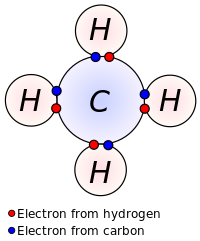
Early concepts in covalent bonding arose from this kind of image of the molecule of methane. Covalent bonding is implied in the Lewis structure by indicating electrons shared betwixt atoms.
The term covalence in regard to bonding was first used in 1919 past Irving Langmuir in a Journal of the American Chemical Society article entitled "The Arrangement of Electrons in Atoms and Molecules". Langmuir wrote that "we shall denote past the term covalence the number of pairs of electrons that a given atom shares with its neighbors."[6]
The idea of covalent bonding can be traced several years before 1919 to Gilbert N. Lewis, who in 1916 described the sharing of electron pairs between atoms.[seven] He introduced the Lewis notation or electron dot notation or Lewis dot structure, in which valence electrons (those in the outer shell) are represented as dots effectually the diminutive symbols. Pairs of electrons located between atoms represent covalent bonds. Multiple pairs represent multiple bonds, such as double bonds and triple bonds. An alternative course of representation, not shown here, has bail-forming electron pairs represented equally solid lines.[8]
Lewis proposed that an atom forms enough covalent bonds to grade a total (or closed) outer electron shell. In the diagram of methyl hydride shown here, the carbon cantlet has a valence of four and is, therefore, surrounded by eight electrons (the octet rule), four from the carbon itself and four from the hydrogens bonded to it. Each hydrogen has a valence of i and is surrounded by two electrons (a duet rule) – its ain i electron plus one from the carbon. The numbers of electrons correspond to full shells in the breakthrough theory of the atom; the outer shell of a carbon atom is the n = 2 shell, which can hold eight electrons, whereas the outer (and only) beat of a hydrogen atom is the n = 1 trounce, which can hold simply 2.[9]
While the idea of shared electron pairs provides an effective qualitative picture of covalent bonding, quantum mechanics is needed to sympathize the nature of these bonds and predict the structures and properties of simple molecules. Walter Heitler and Fritz London are credited with the first successful quantum mechanical explanation of a chemical bond (molecular hydrogen) in 1927.[10] Their work was based on the valence bond model, which assumes that a chemic bond is formed when there is practiced overlap betwixt the atomic orbitals of participating atoms.
Types of covalent bonds [edit]
Atomic orbitals (except for s orbitals) have specific directional properties leading to different types of covalent bonds. Sigma (σ) bonds are the strongest covalent bonds and are due to head-on overlapping of orbitals on two different atoms. A unmarried bond is ordinarily a σ bond. Pi (π) bonds are weaker and are due to lateral overlap between p (or d) orbitals. A double bond between two given atoms consists of i σ and one π bond, and a triple bond is one σ and two π bonds.[eight]
Covalent bonds are too affected past the electronegativity of the connected atoms which determines the chemical polarity of the bond. Two atoms with equal electronegativity will make nonpolar covalent bonds such every bit H–H. An unequal human relationship creates a polar covalent bond such as with H−Cl. Yet polarity too requires geometric disproportion, or else dipoles may cancel out resulting in a not-polar molecule.[8]
Covalent structures [edit]
There are several types of structures for covalent substances, including individual molecules, molecular structures, macromolecular structures and behemothic covalent structures. Individual molecules have stiff bonds that hold the atoms together, only more often than not, in that location are negligible forces of attraction between molecules. Such covalent substances are usually gases, for example, HCl, Soii, CO2, and CHiv. In molecular structures, there are weak forces of allure. Such covalent substances are low-boiling-temperature liquids (such as ethanol), and low-melting-temperature solids (such as iodine and solid CO2). Macromolecular structures have large numbers of atoms linked by covalent bonds in chains, including constructed polymers such as polyethylene and nylon, and biopolymers such equally proteins and starch. Network covalent structures (or behemothic covalent structures) contain big numbers of atoms linked in sheets (such every bit graphite), or 3-dimensional structures (such as diamond and quartz). These substances take loftier melting and boiling points, are frequently brittle, and tend to have high electric resistivity. Elements that take high electronegativity, and the ability to form three or four electron pair bonds, often grade such large macromolecular structures.[11]
One- and 3-electron bonds [edit]

Bonds with ane or three electrons tin can be found in radical species, which accept an odd number of electrons. The simplest example of a 1-electron bond is constitute in the dihydrogen cation, H +
two . I-electron bonds frequently have nearly half the bond free energy of a 2-electron bond, and are therefore called "half bonds". However, in that location are exceptions: in the example of dilithium, the bail is really stronger for the 1-electron Li +
two than for the two-electron Litwo. This exception can be explained in terms of hybridization and inner-shell effects.[12]
The simplest case of iii-electron bonding can exist found in the helium dimer cation, He +
two . It is considered a "half bail" because it consists of just one shared electron (rather than two);[xiii] in molecular orbital terms, the tertiary electron is in an anti-bonding orbital which cancels out half of the bond formed by the other two electrons. Some other example of a molecule containing a 3-electron bond, in addition to two 2-electron bonds, is nitric oxide, NO. The oxygen molecule, O2 tin can also be regarded every bit having 2 iii-electron bonds and one 2-electron bond, which accounts for its paramagnetism and its formal bond lodge of 2.[14] Chlorine dioxide and its heavier analogues bromine dioxide and iodine dioxide as well incorporate three-electron bonds.
Molecules with odd-electron bonds are usually highly reactive. These types of bail are only stable between atoms with like electronegativities.[fourteen]

Nitric oxide

Dioxygen
Resonance [edit]
There are situations whereby a single Lewis structure is insufficient to explain the electron configuration in a molecule and its resulting experimentally-determined properties, hence a superposition of structures is needed. The same two atoms in such molecules can exist bonded differently in different Lewis structures (a single bond in one, a double bond in some other, or even none at all), resulting in a non-integer bond order. The nitrate ion is 1 such example with iii equivalent structures. The bond between the nitrogen and each oxygen is a double bond in one structure and a unmarried bail in the other ii, so that the boilerplate bond club for each North–O interaction is 2 + 1 + 1 / 3 = iv / iii .[8]

Aromaticity [edit]
In organic chemistry, when a molecule with a planar ring obeys Hückel's rule, where the number of π electrons fit the formula 4north + 2 (where northward is an integer), information technology attains extra stability and symmetry. In benzene, the prototypical aromatic compound, there are half dozen π bonding electrons (n = 1, fourn + 2 = 6). These occupy three delocalized π molecular orbitals (molecular orbital theory) or form conjugate π bonds in two resonance structures that linearly combine (valence bail theory), creating a regular hexagon exhibiting a greater stabilization than the hypothetical i,3,5-cyclohexatriene.[9]
In the instance of heterocyclic aromatics and substituted benzenes, the electronegativity differences between different parts of the band may boss the chemic behavior of aromatic band bonds, which otherwise are equivalent.[9]
Hypervalence [edit]
Sure molecules such equally xenon difluoride and sulfur hexafluoride have higher co-ordination numbers than would be possible due to strictly covalent bonding according to the octet rule. This is explained by the iii-heart four-electron bond ("3c–4e") model which interprets the molecular wavefunction in terms of non-bonding highest occupied molecular orbitals in molecular orbital theory and resonance of sigma bonds in valence bond theory.[15]
Electron deficiency [edit]
In three-centre two-electron bonds ("3c–2e") three atoms share two electrons in bonding. This blazon of bonding occurs in boron hydrides such equally diborane (B2Hsix), which are often described as electron scarce considering in that location are not enough valence electrons to form localized (2-centre two-electron) bonds joining all the atoms. However the more modern clarification using 3c–2e bonds does provide enough bonding orbitals to connect all the atoms, so that the molecules can instead exist classified as electron-precise.
Each such bond (2 per molecule in diborane) contains a pair of electrons which connect the boron atoms to each other in a banana shape, with a proton (the nucleus of a hydrogen atom) in the middle of the bond, sharing electrons with both boron atoms. In certain cluster compounds, so-chosen four-centre 2-electron bonds also accept been postulated.[16]
Breakthrough mechanical description [edit]
Afterwards the development of quantum mechanics, two basic theories were proposed to provide a quantum clarification of chemical bonding: valence bail (VB) theory and molecular orbital (MO) theory. A more recent breakthrough description[17] is given in terms of atomic contributions to the electronic density of states.
Comparison of VB and MO theories [edit]
The two theories stand for two ways to build up the electron configuration of the molecule.[18] For valence bail theory, the atomic hybrid orbitals are filled with electrons first to produce a fully bonded valence configuration, followed by performing a linear combination of contributing structures (resonance) if there are several of them. In contrast, for molecular orbital theory a linear combination of atomic orbitals is performed first, followed by filling of the resulting molecular orbitals with electrons.[8]
The 2 approaches are regarded as complementary, and each provides its own insights into the problem of chemical bonding. As valence bond theory builds the molecular wavefunction out of localized bonds, it is more suited for the calculation of bond energies and the agreement of reaction mechanisms. Every bit molecular orbital theory builds the molecular wavefunction out of delocalized orbitals, information technology is more suited for the adding of ionization energies and the understanding of spectral absorption bands.[xix]
At the qualitative level, both theories contain incorrect predictions. Simple (Heitler–London) valence bond theory correctly predicts the dissociation of homonuclear diatomic molecules into separate atoms, while unproblematic (Hartree–Fock) molecular orbital theory incorrectly predicts dissociation into a mixture of atoms and ions. On the other hand, simple molecular orbital theory correctly predicts Hückel's rule of aromaticity, while simple valence bond theory incorrectly predicts that cyclobutadiene has larger resonance free energy than benzene.[20]
Although the wavefunctions generated by both theories at the qualitative level do not agree and do not lucifer the stabilization energy past experiment, they can be corrected by configuration interaction.[18] This is done by combining the valence bond covalent function with the functions describing all possible ionic structures or by combining the molecular orbital ground state office with the functions describing all possible excited states using unoccupied orbitals. It can and so be seen that the elementary molecular orbital approach overestimates the weight of the ionic structures while the simple valence bond arroyo neglects them. This tin too be described as proverb that the simple molecular orbital arroyo neglects electron correlation while the simple valence bail approach overestimates it.[18]
Modern calculations in quantum chemical science unremarkably start from (but ultimately get in beyond) a molecular orbital rather than a valence bond approach, not because of any intrinsic superiority in the former but rather because the MO approach is more readily adjusted to numerical computations. Molecular orbitals are orthogonal, which significantly increases the feasibility and speed of computer calculations compared to nonorthogonal valence bond orbitals.

Yet, now there is a technology for direct visualization of valence bonds by electron deject densitometry.[21]
Covalency from diminutive contribution to the electronic density of states [edit]
In COOP,[22] COHP[23] and BCOOP,[24] evaluation of bond covalency is dependent on the footing set. To overcome this issue, an alternative formulation of the bond covalency can exist provided in this way.
The center mass cm(n,l,m50 ,one thousands ) of an diminutive orbital |due north,l,one thousand50 ,1000s ⟩, with quantum numbers n, l, m50 , ms , for atom A is divers every bit
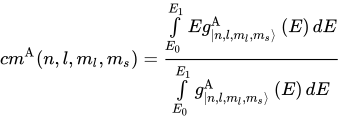
where g A
|n,l,gl ,msouth ⟩ (E) is the contribution of the atomic orbital |n,l,kfifty ,ms ⟩ of the atom A to the total electronic density of states g(E) of the solid

where the outer sum runs over all atoms A of the unit prison cell. The energy window [Eastward 0,E 1] is called in such a way that information technology encompasses all of the relevant bands participating in the bond. If the range to select is unclear, it tin be identified in practise by examining the molecular orbitals that describe the electron density along with the considered bail.
The relative position C n A fifty A,due north B l B of the center mass of |n A,l A⟩ levels of cantlet A with respect to the eye mass of |due north B,fifty B⟩ levels of atom B is given equally

where the contributions of the magnetic and spin breakthrough numbers are summed. Co-ordinate to this definition, the relative position of the A levels with respect to the B levels is

where, for simplicity, we may omit the dependence from the chief breakthrough number northward in the notation referring to C n A fifty A,n B l B .
In this ceremonial, the greater the value of C A,B , the higher the overlap of the selected atomic bands, and thus the electron density described past those orbitals gives a more covalent A–B bond. The quantity C A,B is denoted as the covalency of the A–B bond, which is specified in the same units of the energy E.
Come across also [edit]
- Bonding in solids
- Bond order
- Coordinate covalent bond, too known as a dipolar bond or a dative covalent bond
- Covalent bond nomenclature (or LXZ notation)
- Covalent radius
- Disulfide bond
- Hybridization
- Hydrogen bond
- Ionic bond
- Linear combination of atomic orbitals
- Metallic bonding
- Noncovalent bonding
- Resonance (chemistry)
References [edit]
- ^ Campbell, Neil A.; Williamson, Brad; Heyden, Robin J. (2006). Biology: Exploring Life. Boston, MA. ISBN0-13-250882-6 . Retrieved 2012-02-05 .
- ^ March, Jerry (1992). Advanced Organic Chemistry: Reactions, Mechanisms, and Construction . John Wiley & Sons. ISBN0-471-60180-2.
- ^ Gary 50. Miessler; Donald Arthur Tarr (2004). Inorganic Chemistry . Prentice Hall. ISBN0-thirteen-035471-half-dozen.
- ^ Merriam-Webster – Collegiate Dictionary (2000).
- ^ "Chemical Bonds". Hyperphysics.phy-astr.gsu.edu. Retrieved 2013-06-09 .
- ^ Langmuir, Irving (1919-06-01). "The Arrangement of Electrons in Atoms and Molecules". Journal of the American Chemical Society. 41 (6): 868–934. doi:10.1021/ja02227a002.
- ^ Lewis, Gilbert N. (1916-04-01). "The cantlet and the molecule". Journal of the American Chemic Society. 38 (4): 762–785. doi:10.1021/ja02261a002.
- ^ a b c d due east McMurry, John (2016). Chemistry (seven ed.). Pearson. ISBN978-0-321-94317-0.
- ^ a b c Bruice, Paula (2016). Organic Chemistry (viii ed.). Pearson. ISBN978-0-13-404228-2.
- ^ a b Heitler, W.; London, F. (1927). "Wechselwirkung neutraler Atome und homöopolare Bindung nach der Quantenmechanik" [Interaction of neutral atoms and homeopolar bonds according to quantum mechanics]. Zeitschrift für Physik. 44 (six–7): 455–472. Bibcode:1927ZPhy...44..455H. doi:10.1007/bf01397394. S2CID 119739102. English translation in Hettema, H. (2000). Quantum Chemical science: Classic Scientific Papers. Globe Scientific. p. 140. ISBN978-981-02-2771-five . Retrieved 2012-02-05 .
- ^ Stranks, D. R.; Heffernan, One thousand. L.; Lee Dow, K. C.; McTigue, P. T.; Withers, Grand. R. A. (1970). Chemical science: A structural view. Carlton, Vic.: Melbourne University Press. p. 184. ISBN0-522-83988-half-dozen.
- ^ Weinhold, F.; Landis, C. (2005). Valency and Bonding. Cambridge. pp. 96–100. ISBN0-521-83128-viii.
- ^ Harcourt, Richard D., ed. (2015). "Chapter 2: Pauling "iii-Electron Bonds", 4-Electron iii-Heart Bonding, and the Demand for an "Increased-Valence" Theory". Bonding in Electron-Rich Molecules: Qualitative Valence-Bail Arroyo via Increased-Valence Structures. Springer. ISBN9783319166766.
- ^ a b Pauling, Fifty. (1960). The Nature of the Chemical Bond . Cornell University Press. pp. 340–354.
- ^ Weinhold, F.; Landis, C. (2005). Valency and Bonding. Cambridge University Press. pp. 275–306. ISBN0521831288.
- ^ Hofmann, K.; Prosenc, One thousand. H.; Albert, B. R. (2007). "A new 4c–2e bond in B
half-dozen H −
7 ". Chemic Communications. 2007 (29): 3097–3099. doi:10.1039/b704944g. PMID 17639154. - ^ Cammarata, Antonio; Rondinelli, James M. (21 September 2014). "Covalent dependence of octahedral rotations in orthorhombic perovskite oxides". Journal of Chemical Physics. 141 (11): 114704. Bibcode:2014JChPh.141k4704C. doi:10.1063/ane.4895967. PMID 25240365.
- ^ a b c Atkins, P. Westward. (1974). Quanta: A Handbook of Concepts. Oxford University Press. pp. 147–148. ISBN978-0-19-855493-6.
- ^ James D. Ingle Jr. and Stanley R. Crouch, Spectrochemical Assay, Prentice Hall, 1988, ISBN 0-13-826876-ii
- ^ Anslyn, Eric 5. (2006). Modern Concrete Organic Chemistry. University Science Books. ISBN978-ane-891389-31-3.
- ^ a b Kucherov, O. P. (2021). "Straight Visualization of Covalent Chemical Bonds in Crystalline Silicon" (PDF). American Journal of Applied science Research (AJER). 10 (vi): 54–58.
- ^ Hughbanks, Timothy; Hoffmann, Roald (2002-05-01). "Chains of trans-edge-sharing molybdenum octahedra: metallic-metallic bonding in extended systems". Journal of the American Chemic Guild. 105 (11): 3528–3537. doi:10.1021/ja00349a027.
- ^ Dronskowski, Richard; Bloechl, Peter E. (2002-05-01). "Crystal orbital Hamilton populations (COHP): energy-resolved visualization of chemical bonding in solids based on density-functional calculations". The Journal of Physical Chemical science. 97 (33): 8617–8624. doi:x.1021/j100135a014.
- ^ Grechnev, Alexei; Ahuja, Rajeev; Eriksson, Olle (2003-01-01). "Balanced crystal orbital overlap population—a tool for analysing chemical bonds in solids". Journal of Physics: Condensed Affair. 15 (45): 7751. Bibcode:2003JPCM...15.7751G. doi:10.1088/0953-8984/15/45/014. ISSN 0953-8984.
Sources [edit]
- "Covalent bonding – Unmarried bonds". chemguide. 2000. Retrieved 2012-02-05 .
- "Electron Sharing and Covalent Bonds". Department of Chemistry University of Oxford. Retrieved 2012-02-05 .
- "Chemic Bonds". Department of Physics and Astronomy, Georgia State Academy. Retrieved 2012-02-05 .
External links [edit]
- Covalent Bonds and Molecular Construction
- Structure and Bonding in Chemistry—Covalent Bonds
mcconnellonat1989.blogspot.com
Source: https://en.wikipedia.org/wiki/Covalent_bond
0 Response to "Our Answer Is Incorrect. Try Again. Draw All Lone Pairs of Electrons for the Following Compound."
ارسال یک نظر